
NASEM Report: Small Firms, Big Wins in Defense Innovation
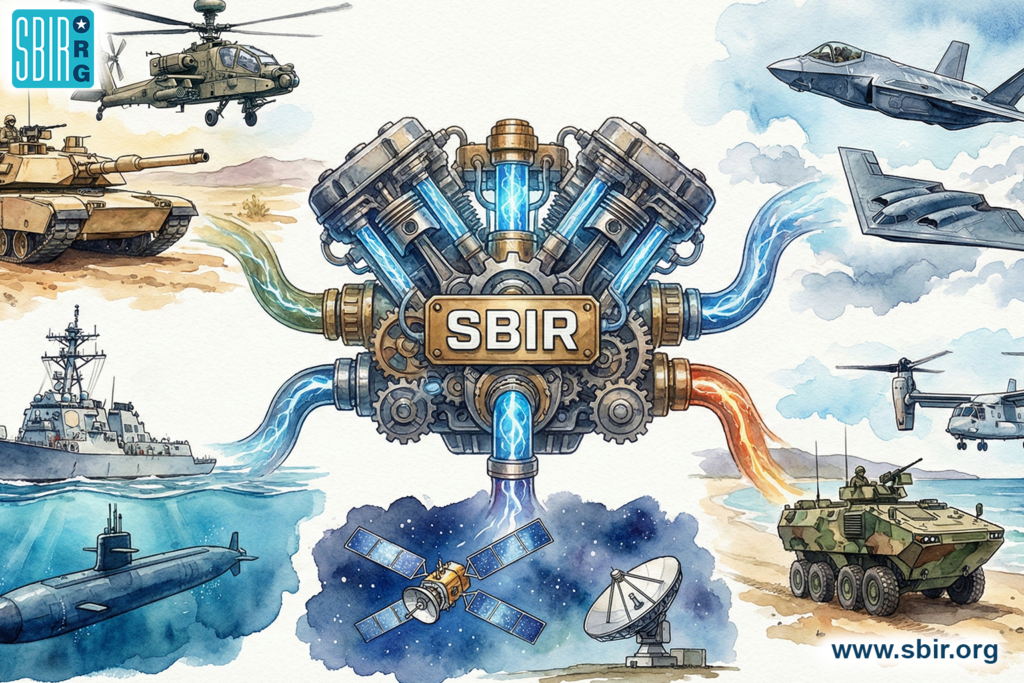
January 15, 2026 — When a storied scientific institution weighs in on a government program, policymakers tend to listen. The National Academies of Sciences, Engineering, and Medicine – an independent, congressionally chartered organization – has built a reputation for providing “independent, trustworthy advice” on complex scientific and technical issues(**). Now, a new National Academies report offers a powerful validation of two long-running Department of Defense initiatives that many Americans have never heard of: the Small Business Innovation Research (SBIR) and Small Business Technology Transfer (STTR) programs. These programs, created in the 1980s to spur technological innovation by small companies, are quietly shaping the future of U.S. defense. And according to the National Academies’ assessment, they’re doing so with striking success.
This 2026 report – Review of the SBIR and STTR Programs at the Department of Defense – arrives at a critical moment. In Washington, lawmakers have been debating the future of SBIR/STTR as the programs come up for reauthorization. The National Academies’ analysis carries weight because it is both independent and authoritative: a committee of experts spent months scrutinizing data and evidence. Their conclusion is unambiguous. The SBIR and STTR initiatives “consistently deliver outsized returns for both the warfighter and America’s small business innovation ecosystem”, the report finds(**). In plain terms, these small-business R&D grants are punching far above their weight, translating federal research dollars into scientific innovation, new products for national security, and commercial growth for private companies.
Inside SBIR/STTR: Small Businesses Solving Big Defense Needs
Under SBIR and STTR, the Pentagon and other federal agencies reserve a small portion of their research budgets to award competitive contracts to innovative little firms. The idea is to tap into the creativity of entrepreneurs and scientists who might not otherwise work with the military. Over three phased stages, companies first prove a concept (Phase I), then develop it into a prototype (Phase II), and finally (if successful) transition it to real-world use (Phase III, often through follow-on contracts or sales). STTR projects specifically require a partnership with a nonprofit research institution (like a university), ensuring that small businesses collaborate with academia on cutting-edge ideas.
For more than four decades, the Defense Department has used these programs to seed inventions ranging from advanced materials and drones to cybersecurity tools. But how well do they actually work? The National Academies committee – comprised of professors, industry veterans, and former defense officials – dug into mountains of data to find out. Their study examined the “economic and noneconomic benefits” of SBIR/STTR at DoD, evaluating whether these grants truly stimulate innovation, meet military needs, and bring new players into the defense sector. The resulting 278 page report paints a picture of programs that are integral to the Pentagon’s R&D enterprise – and possibly more important than even some supporters realized.
One fundamental finding is that small businesses have become indispensable contributors to defense technology. Companies supported by SBIR/STTR now fulfill a “significant and growing share” of the Defense Department’s external R&D needs. In fact, the report notes these firms account for nearly one-third of the Pentagon’s entire extramural R&D base. In other words, out of all the entities conducting research for the Department of Defense – from big primes like Lockheed Martin down to university labs – almost one in three is a small business funded by SBIR or STTR. This marks a dramatic increase in small-business engagement in defense innovation since the programs began in the 1980s. It means that the U.S. military’s arsenal of ideas is no longer drawn mostly from giants or government labs; a substantial slice now comes from scrappy startups and tech-focused small enterprises. The National Academies underscores that this diversity of contributors strengthens the U.S. industrial base and injects fresh innovation into defense.
Follow the Money: Big Returns on Small Business Research
Perhaps the most eye-catching evidence in the report is numerical. By the numbers, SBIR and STTR at DoD are yielding robust returns on investment. The study’s quantitative analysis found that many SBIR/STTR projects don’t stop with the initial government grant – they attract much more funding to further develop and deploy their innovations. According to the National Academies findings, for every dollar the Defense Department invests through SBIR or STTR, participating firms go on to attract more than four dollars in additional DOD funding beyond the SBIR/STTR program. This 4-to-1 leverage is a concrete indicator of the programs’ value. It means that a modest Phase I or II contract from the Pentagon often serves as a springboard, enabling the company to win much larger follow-on contracts from the military (or sometimes from private investors or other customers) to bring the technology to fruition. In budgetary terms, the small-business programs are a force multiplier: a relatively small pot of seed money is catalyzing much larger infusions of capital to advance defense innovation.
Crucially, those follow-on dollars correspond to real-world impact. A core goal of SBIR/STTR is commercialization – turning research into products or services that people use, whether in the military or civilian marketplace. The Defense Department cares especially about “Phase III” results, where a prototype is adopted into a program of record or purchased for use by soldiers, sailors, airmen, or Marines. The National Academies report indicates that many SBIR/STTR projects have indeed transitioned successfully, as evidenced by the flow of non-SBIR defense dollars chasing them. The 4-to-1 follow-on funding statistic is “clear evidence that early-stage small business innovation translates into scalable, mission-ready solutions,” the report observes. For example, a company that invented a new sensor under an SBIR contract might later win a multi-million dollar deal to integrate that sensor into an aircraft – a sign that the innovation proved its worth. Such outcomes directly contribute to U.S. military capabilities, showing how SBIR/STTR investments feed into national security.
The report also highlights the commercial spillover effects of SBIR/STTR-funded research. While the Academies’ study focuses on defense needs, many SBIR companies leverage their military-developed tech for civilian markets as well – a fact noted in previous assessments of the program. A novel material or software algorithm initially designed for, say, an Army vehicle might find later use in commercial automobiles or consumer electronics. This dual-use potential means taxpayer-funded research can yield economic benefits beyond the defense sector. By nurturing high-tech small businesses, SBIR and STTR not only help the Pentagon but also contribute to American competitiveness in industries like aerospace, biotech, and computing.
Innovation Network: From Lab Bench to Battlefield
Another striking finding of the National Academies report is how effectively SBIR and STTR serve as a bridge between inventive small firms and the larger defense industry. Innovation in defense is not a solo act – new technologies often need to plug into complex systems, which means small businesses frequently partner with major defense contractors to bring their products to the field. The study found “strong knowledge transfer from SBIR/STTR awardees to prime defense contractors”, underscoring the programs’ role in strengthening the broader defense industrial base. In practice, this knowledge transfer can take many forms. Sometimes a small company’s technology is licensed or supplied to a big prime like Boeing or Raytheon for incorporation into a weapons system. In other cases, the small firm might even be acquired by a larger company, which is one way innovations scale up. The report’s message is that SBIR/STTR has become a pipeline feeding fresh ideas and intellectual property into major defense acquisition programs, ensuring that even the biggest Pentagon contractors benefit from the nimbleness and creativity of startups.
This dynamic has important implications for national security. It suggests that programs like SBIR and STTR help cast a wider net for innovation, so the military isn’t reliant only on the R&D coming out of a few large corporations. By facilitating partnerships and technology transfer, the programs enhance collaboration across the defense ecosystem. A small cyber defense company in Silicon Valley, for instance, might solve a problem that eventually protects a Navy network – via a contract with a larger systems integrator that brings the solution to scale. The National Academies panel notes that such synergies are a feature, not a bug, of SBIR/STTR. The programs were deliberately designed to harness the ingenuity of America’s “small business innovation ecosystem” for military needs, and the evidence shows that ecosystem is now deeply interwoven with the Pentagon’s own operations.
Notably, the SBIR and STTR programs also encourage collaboration with universities (particularly through STTR projects). This helps transfer cutting-edge science from academic labs into applied research at small companies. The report points out that STTR has been effective in stimulating new partnerships between businesses and research institutions, although it also examines barriers – for example, the challenge of attracting minority-serving universities into the mix. Such insights reveal the nuanced roles of the twin programs: SBIR taps the entrepreneurial zeal of companies, while STTR builds bridges to academia. Together, they expand the defense innovation network in ways traditional contracting mechanisms might not achieve.
Policy Crossroads: Debating the “Experienced Firms”
Despite the largely positive verdict, the National Academies study does grapple with a contentious issue that has loomed over SBIR/STTR: the question of firms that win many awards. A subset of small businesses have participated in SBIR/STTR repeatedly over the years, earning reputations (sometimes derisively) as “SBIR mills.” Critics argue that some of these firms chase grants without transitioning projects to useful products, potentially crowding out new innovators. In recent Congressional debates, proposals emerged to cap how many awards a single firm can receive or to enforce stricter benchmarks on commercialization success before allowing a company to win another grant.
The National Academies committee examined this issue in depth – and its findings push back against the idea of arbitrary limits. The report finds that experienced SBIR/STTR firms actually play a vital role in the defense innovation ecosystem, often accumulating expertise that enables them to tackle especially complex R&D challenges. Far from being deadweight, many repeat winners have become go-to problem solvers for certain military needs. The committee concluded that “restricting their participation would actively harm DoD’s ability to deliver cutting-edge technologies quickly”. In other words, excluding companies just because they’ve succeeded before could deprive the Pentagon of some of its most seasoned small-business innovators.
Instead of one-size-fits-all limits, the report recommends a more flexible approach. Congress, it says, should preserve flexibility for program managers to select the best proposals and most capable firms – whether newcomers or veterans – rather than imposing rigid caps based solely on prior awards. This advice carries particular resonance as the SBIR/STTR programs face reauthorization: lawmakers are urged to avoid reforms that could inadvertently sideline high-performing firms. The Academies’ stance is that merit and the urgency of warfighter needs should guide awards, not an arbitrary count of past wins. It’s a clear signal from an independent arbiter that the focus should remain on outcomes – getting good technology to those who need it – rather than reshuffling the participant pool for its own sake.
A Program Indispensable to Innovation and Security
Overall, the National Academies’ review delivers a resounding endorsement of the SBIR and STTR programs at the Defense Department. It portrays them as catalysts of innovation that not only generate new technologies but also weave a richer tapestry of contributors to national security. The findings underscore that a once-modest initiative has evolved into a cornerstone of America’s defense R&D strategy, integrating small businesses into missions of the highest importance. Quantitatively, the evidence is compelling: nearly a third of Defense Department research contributors are SBIR/STTR firms, and each taxpayer dollar invested through these programs has multiplied into four or more dollars’ worth of further development and procurement. Qualitatively, the programs have opened doors for entrepreneurs and researchers, enabling them to tackle military problems and in doing so, feed their innovations into both defense and commercial markets.
The National Academies of Sciences, Engineering, and Medicine – in keeping with its mandate – approached the task as a neutral evaluator, and its report comes across as neither boosterism nor bureaucratic critique, but rather a fact-driven analysis. That is exactly why its assessment carries weight. As an “unwaveringly objective” voice, the Academies remind us that behind the acronyms SBIR and STTR lies a policy success story. For policymakers, the takeaway is clear: nurturing small business innovation is not a side project for the Pentagon; it is a strategic imperative for keeping the United States on the cutting edge. And for the scientists and entrepreneurs hoping to work with the Department of Defense, the report is an encouraging sign that their contributions are recognized as vital. In the high-stakes arena of national security, innovation can come from anywhere – a venture-backed startup, a spin-off from academia, or a one-garage workshop with a big idea. Thanks to SBIR and STTR, many of those ideas now have a pathway from obscurity to impact, a journey affirmed and illuminated by this authoritative review.