
From Jet Tanks to Crowds: Lifeline’s SBIR Path
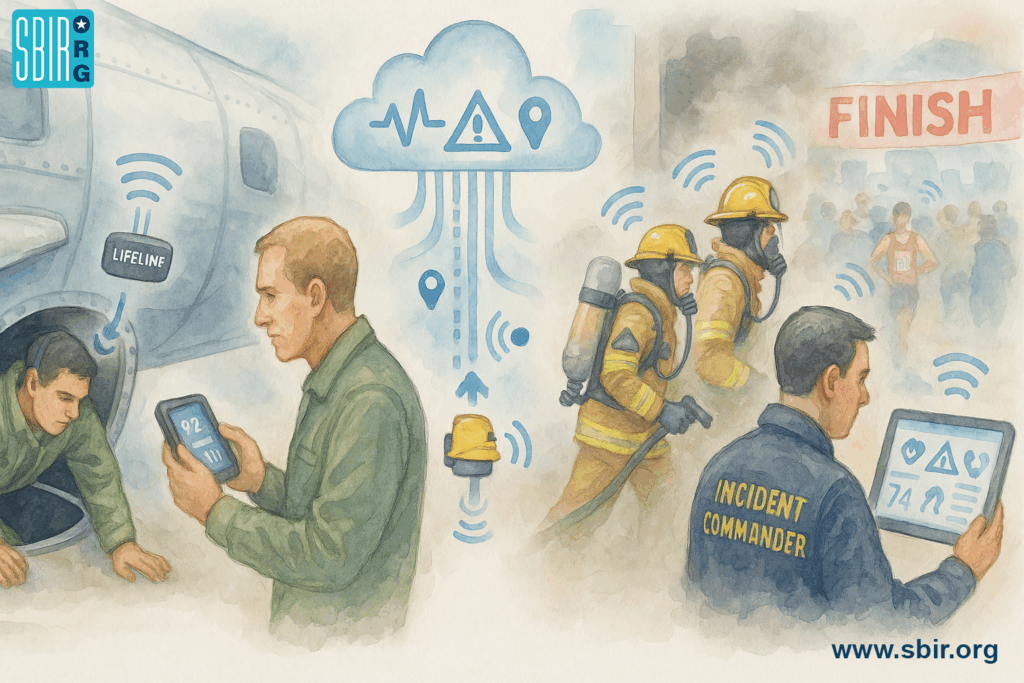
At a championship game or a presidential inauguration, security teams quietly scan the perimeter, on alert for threats. What the public doesn’t see is an unobtrusive network of sensors working behind the scenes. Even as crowds cheer, Safe Environment Engineering’s “Lifeline” system is silently sampling the air and tracking conditions in real time, ready to warn first responders of any invisible danger(**). This military-grade safety net now guarding civilian crowds had an unlikely origin: the cramped, hazardous confines of aircraft fuel tanks.
Born in Confined Spaces
In the early 1990s, California-based Safe Environment Engineering (SEE) set out to solve a deadly industrial problem. OSHA regulations require that any worker entering a closed space – a jet fuel tank, a storage vault – be monitored by a safety attendant nearby. SEE worked with OSHA to develop an electronic device that could serve as that attendant, a system they dubbed “Lifeline.” The Lifeline system allowed a single safety officer to remotely watch over multiple workers in confined spaces, with built-in alarms, two-way voice communication, and emergency dispatch capabilities. Major aerospace companies like McDonnell Douglas, General Dynamics, Boeing, and Northrop Grumman were early adopters, using Lifeline to enhance worker safety while reducing labor costs.
The U.S. Air Force soon took notice. In 2005, recognizing the technology’s potential to protect its maintenance crews, the Air Force awarded SEE a Small Business Innovation Research (SBIR) contract to advance the Lifeline system. With SBIR funding, SEE expanded Lifeline’s capabilities dramatically – adding a suite of environmental sensors to detect chemical, biological, radiological, nuclear and explosive threats (the full CBRNE spectrum) and building a custom wireless platform to transmit all that data in a standardized format. The upgraded Lifeline could now stream readings and alerts in real time over secure Wi-Fi, cellular networks, or the internet, making the information accessible anywhere it was needed. Essentially, the once-simple tether for a tank worker evolved into a robust Internet-of-Things safety network. “The SBIR helped us transition our products from a lower bandwidth telemetry system to a fully networked architecture,” said David Lamensdorf, SEE’s president. “This paradigm shift expanded our coverage footprint from an in-building solution to a regional/global system provider, greatly expanding our markets beyond confined space to now include homeland security, public safety, and defense”. (The SBIR program, launched in 1982, is specifically designed to spur innovations like this with both military and public benefit in mind(**).)
Protecting the Home Front
Armed with new capabilities, the Lifeline system quickly found uses far beyond fuel tanks. What started as a lifesaving tool for Air Force mechanics became a versatile platform for America’s hometown heroes. Firefighters, hazmat teams, police and even environmental agencies began deploying Lifeline to monitor dangerous situations in real time. The Los Angeles City Fire Department, for example, integrated SEE’s system into its hazardous materials units – built into protective gear and response vehicles – to keep crews connected and informed on scene. “The Los Angeles City Fire Department utilizes Safe Environment Engineering’s systems both as part of our Hazmat teams’ personal protective equipment as well as an integral component of our Hazmat apparatus,” said Capt. Robert M. Dunivin of the LAFD Homeland Security Division’s CBRNE/Hazmat section(**). “Combined with FirstNet, we have the connectivity and capabilities we need to keep our first responders and Angelenos safe,” he said, referring to the nationwide public-safety broadband network.
Scaled up to cover wide areas, Lifeline has been used by the Environmental Protection Agency to monitor hazardous conditions in the aftermath of natural disasters like Superstorm Sandy and Hurricane Irma. State and local agencies have deployed the system at large public events – from the Boston Marathon to the Long Beach Grand Prix to presidential inaugurations – where it provides an extra layer of invisible protection for crowds. The same technology originally built to safeguard Air Force depot workers is now helping “protect public crowds” in open arenas. Even the U.S. Navy installed Lifeline at Pearl Harbor Naval Shipyard to protect ship maintenance crews, and Tinker Air Force Base – where the concept first took root – made the upgraded system standard for its personnel.
Front-line responders say this real-time environmental awareness is a game-changer. Los Angeles Fire Department Chief J. Lesinski, who oversaw Lifeline’s use during the 2016 Academy Awards in Hollywood, described how it empowers emergency managers to act before a threat escalates. “Once we have situational awareness [through Lifeline], we can provide the appropriate protective actions for emergency management,” Lesinski said. “Our goal is to limit loss, to reduce the threat through early detection, share the information with decision makers, and provide safety for first responders and the public.” In practical terms, the system can feed a fire incident commander live readings of toxic gas levels or radiation on a firefighter’s handheld device, or instantly alert a team if a confined-space worker stops moving. During the intense wildfire siege that hit Los Angeles in 2025, the LAFD deployed Lifeline’s latest iteration to track smoke and air quality in real time, streaming data to command centers. The live sensor feeds, combined with mapping and plume modeling software, guided firefighting crews and helped protect both firefighters and residents on the ground(**). Safe Environment Engineering noted that its system proved a “vital asset in life-saving decisions” during those wildfires, as every second of early warning counted.
From Warfighter to Firefighter
The journey of Lifeline from an Air Force hangar to a firefighter’s turnout gear is a vivid example of dual-use technology – a military innovation finding a second life safeguarding civilians. In 2010, the Department of Homeland Security was so impressed with Lifeline’s potential that it funded a pilot project called ICBRNE to integrate the system into national emergency response. In a two-day Los Angeles exercise simulating a nuclear explosion, Lifeline’s network was put to the test handling data from countless sensors across the city. The result: the system easily managed the “massive amounts of data” – using only 5% of its server capacity – and proved that such connectivity would enable officials to “respond more effectively and save lives” in an actual crisis. The Federal Emergency Management Agency later made this project a case study in how to improve multi-agency disaster response, and lessons from it are now taught in homeland security graduate programs.
For SEE, a small business based in Valencia, Calif., the success of Lifeline validates the SBIR model of innovation. The company is continuing to refine its lifesaving tech: a next-generation Lifeline device is in the works, designed to be even simpler to use and fully integrated into the modern Internet of Things – meaning an array of smart devices seamlessly sharing data on the fly. It’s all part of what Lamensdorf calls a paradigm shift that SBIR funding set in motion. “The Air Force SBIR was critical in bringing this valuable technology into the public safety sphere,” he said, noting that the investment not only solved an Air Force problem but opened vast new markets in “homeland security, public safety, and defense.”
The Lifeline story shows how a tool built to save warfighters can end up saving firefighters. It makes tangible the often abstract notion that defense R&D spending yields civilian dividends. From a lone mechanic crawling inside a jet wing, to an entire marathon crowd on a city street, the same technology has scaled to protect lives in many arenas. And for the firefighters and emergency crews who risk their lives for others, what began as a military experiment has become exactly what its name promises – a lifeline – one that helps ensure America’s heroes come home safe from the hazards they face.