
NIH Emergency Peer Review Changes Explained
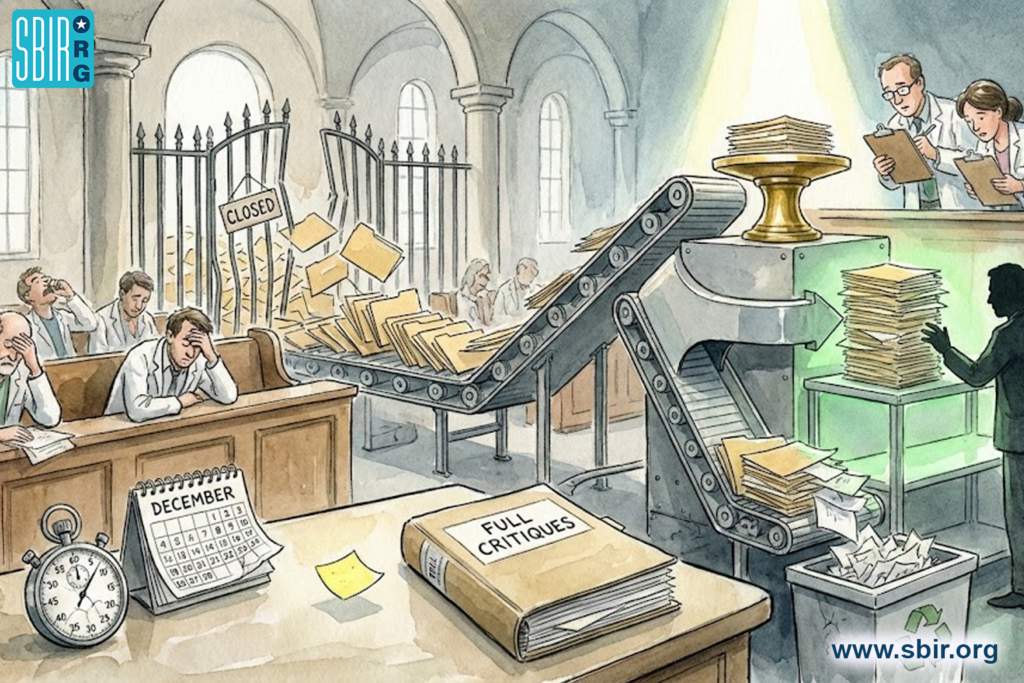
Facing an unprecedented backlog of grant applications caused by a lengthy government shutdown, the National Institutes of Health (NIH) has unveiled temporary but significant adjustments to its peer review process. The goal is to clear the logjam of delayed reviews while maintaining the integrity and fairness of the NIH’s evaluation system(**)(**). More than 370 peer review meetings were canceled during the October–November 2025 federal funding lapse, halting the review of over 24,000 funding applications (including numerous small business SBIR/STTR proposals) and throwing the agency’s schedule into disarray(**). NIH officials are now racing to reschedule those sessions and insist they will still complete three full rounds of peer review in the 2026 fiscal year, as normally planned(**). “We strongly believe canceling a round of review would be harmful to applicants and the research enterprise,” wrote Dr. Bruce Reed, acting director of NIH’s Center for Scientific Review, emphasizing the agency’s commitment to uphold review quality despite the emergency changes(**).
Fewer Applications Discussed Under a New Triage System
To address the backlog, NIH is temporarily overhauling how grant proposals are triaged and discussed in review meetings. Each review panel will sort applications into three groups instead of attempting to discuss them all(**). A typical NIH study section previously deliberated roughly half of the applications under review; under the emergency policy, only about 30–35% of submissions will be discussed, a sharp drop in workload per meeting(**). According to the NIH’s plan, committees will vote on which applications to fully discuss, dividing them into tiers:
- Top third (approximately 30–35%) – the highest-ranked proposals, which will be discussed in detail and considered for funding.
- Middle third – applications deemed “competitive but not discussed,” which will not receive oral discussion during the meeting but remain under consideration for funding by NIH institutes.
- Bottom third – applications viewed as not competitive, which will be triaged without discussion and effectively eliminated from funding contention.
NIH leaders say narrowing the discussion list in this way will significantly streamline the review process. By cutting the number of proposals that must be debated by the committee, most review meetings can conclude in a single day, easing the burden of reconvening large panels of scientists on short notice. This approach also makes it easier to recruit peer reviewers and reschedule missed meetings, which is critical as NIH works to catch up on two overlapping review cycles in early 2026(**).
Simplified Summary Statements and Accelerated Feedback
Alongside the triage measures, NIH is paring down the documentation that comes out of each review. Summary statements – the written critique that applicants receive – will be shorter and more focused during this period. Rather than lengthy narratives of the discussion, the summary for each application will include a one-sentence description of the reviewers’ consensus opinion, followed by bullet-pointed “score-driving” factors that influenced the decision. Written critiques from the three assigned reviewers will still be provided in full, as usual, and for those applications in the top tier that were discussed, the final overall impact score will be reported in the summary statement. NIH is essentially dropping the usual detailed discussion report in favor of a concise rundown of key points and reviewer perspectives, a change designed to save time without omitting crucial feedback.
Crucially, applicants will continue to receive their initial scoring outcomes quickly. Raw priority scores for each proposal will be released within three business days after the study section meets, as is standard practice. However, the full summary statements may arrive later in the cycle – closer to the NIH Institute advisory council meetings that ultimately make funding recommendations. NIH officials note that this delay in written feedback is a trade-off to keep the review cycles moving on schedule even as they accommodate the extra load of rescheduled applications. The expedited scoring is meant to give researchers an early sense of their application’s fate, while the detailed critiques follow a bit later once the compressed review cycle allows time to compile them.
Funding Chances Unchanged – But Be Prepared
For anxious applicants – including many in the small business community – NIH is adamant that these emergency process changes will not lower anyone’s odds of getting funded. In other words, a proposal that falls into the “competitive but not discussed” middle tier is not doomed, but will still be considered for an award alongside those that were discussed in the meeting. By designating both the top and middle groups of applications as “competitive,” NIH is effectively expanding the pool of proposals that could potentially be funded. An application in the middle tier that aligns especially well with an institute’s high-priority research areas could still be picked up for funding, even though it wasn’t formally discussed by the reviewers(**). All institutes and centers have been directed to consider every discussed application and every competitively-ranked undiscussed application when making funding decisions.
NIH has emphasized that an application’s likelihood of funding is not being reduced by the new triage system. “Your application’s funding chances are not affected,” the agency assures researchers. To back up that point, NIH notes that full reviewer critiques will still be available to applicants and to program officials, even for proposals that weren’t discussed out loud. Program officers will remain available to talk with applicants and provide guidance, just as they normally would. In practice, the experience for a researcher may feel different – for instance, seeing a “not discussed” notation on their summary might sting – but all the feedback and agency support mechanisms remain in place, and the proposal can still advance if it fills a priority niche.
A More Competitive and Strategic Landscape Ahead
While billed as temporary, these changes create a more streamlined – and in some ways more competitive – review environment. With barely one-third of submissions getting a full hearing at study sections, applicants are effectively competing harder than before for the attention of reviewers. Some scientists have expressed worry that being “not discussed” could make funding even less likely, given that traditionally very few triaged applications get funded. NIH’s leadership counters that this triage expansion is purely a pragmatic step to manage workload from the shutdown backlog(**), and they underscore that it opens the door for about 15% more applications to be considered for funding in the middle tier than under the usual system. Still, the heightened selectivity raises the stakes for applicants to put their best foot forward.
Research funding advisors say that in this climate it’s more important than ever to craft strategic, well-aligned proposals. “Strong proposals require … well-structured commercialization plans, and clear alignment with NIH priorities,” notes one analysis by a small-business grant consulting firm(**). In other words, projects should closely match the mission and interests of the target NIH institute – something that could make a decisive difference if a not-discussed application is on the bubble for funding. SBIR/STTR applicants, in particular, are reminded that a compelling commercialization rationale is essential to demonstrate the real-world impact and viability of their innovation.
Applicants are also encouraged to engage proactively with NIH program staff as they navigate these changes. Speaking with an NIH program officer early in the process can be a “critical step for success,” according to NIH’s own guidance, since program officers can provide invaluable insight into how well a proposal aligns with an institute’s priorities and mission(**). That kind of communication and clarity of purpose may prove even more crucial in the coming months, as NIH’s compressed review cycles and triage measures make for an increasingly competitive funding arena.
In sum, NIH’s emergency peer review modifications underscore a resolve to push past the shutdown disruptions and keep funding flowing, albeit through a leaner review process. For researchers and small businesses seeking NIH grants, the playing field is undeniably shifting. But with strategic preparation – from sharpening the focus of their proposals to staying in close contact with program officials – applicants can still position themselves for success in this challenging new review landscape.