
NIH Ends Paylines for 2026 Funding
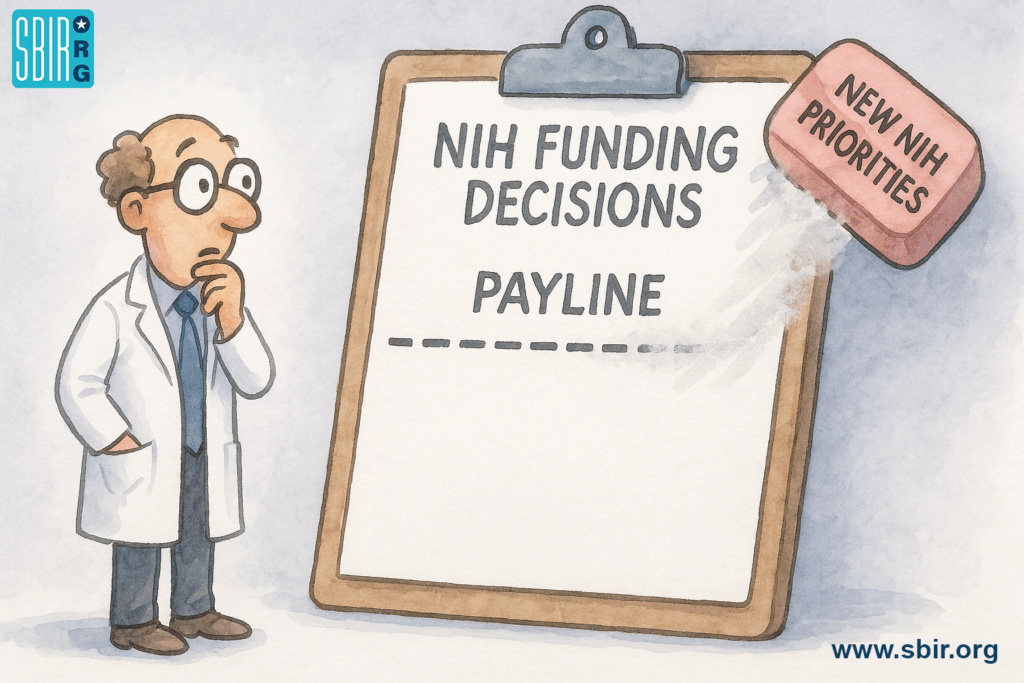
In a major policy shift, the National Institutes of Health (NIH) announced in November 2025 that it will no longer use “paylines” – the score-based funding cutoffs long employed to decide which grant applications get funded(**). Instead of relying on a strict numerical threshold, NIH’s 27 institutes and centers will adopt a more “holistic” approach that weighs each proposal’s alignment with agency priorities, public health needs, and other factors in addition to its peer-review score. The new framework, effective for grant cycles in early 2026, is intended to make funding decisions “clearer and consistent” across NIH and better tuned to mission-driven priorities(**). However, the move away from paylines – a staple of NIH extramural funding for decades – has stirred debate about transparency, fairness, and political influence in science funding.
What Paylines Meant for Researchers
A payline is essentially a score cutoff: if a grant proposal’s peer-review score (often expressed as a percentile) is above that line, it is virtually guaranteed funding, whereas proposals scoring below that threshold are unlikely to be funded. Historically, many NIH institutes published annual paylines as a transparent benchmark for applicants(**). For example, if the National Cancer Institute set a payline at the 12th percentile, an application scoring in the top 10% would almost certainly get funded, while one at the 20th percentile would not. This system gave scientists a clear sense of their chances: “if an application’s percentile score was better than the stated payline, it was highly likely to be funded,” explained a Virginia Tech research administration notice. Above the payline, nearly all proposals were funded; below it, most were not.
Paylines were never an absolute guarantee, but they offered predictability. Applicants who landed safely within the payline could breathe easier, while those outside it knew to revise and resubmit. To be sure, NIH always allowed some exceptions: institutes could still fund an occasional high-priority project that scored outside the payline, or decline a project inside the payline due to budget limits. In practice, roughly half of NIH’s institutes used formal paylines, while others used a more fluid case-by-case approach. Even so, the posted payline served as a crucial yardstick for the research community. As one science policy expert noted, paylines helped investigators gauge whether a grant that scored, say, in the 7th percentile was a sure bet or on shaky ground(**).
Why NIH Made the Change
NIH leaders argue that eliminating rigid paylines will improve funding decisions by looking beyond a single score. According to the NIH Office of Extramural Research, a strict cutoff based only on overall impact score fails to consider “additional valuable information” from peer reviewers’ comments and context(**). Under the new unified strategy, institutes will “consider peer review information in its entirety” when assessing scientific merit, rather than just the numerical ranking. This means program officers and institute directors will read the reviewers’ critiques and factor in nuances – recognizing, for instance, if a project addresses an emerging public health threat or employs an innovative approach that the raw score might not fully reflect.
Strategic priorities will explicitly inform funding choices. NIH has outlined a set of core tenets for its funding policy: ensure research aligns with the NIH mission and each institute’s strategic plan, maintain a broad portfolio of topics, support early-career investigators, and promote a “robust biomedical workforce,” among others. Notably, NIH now emphasizes “broad distribution and geographic balance of funding” and mindful stewardship of taxpayer dollars. In other words, beyond scientific merit, decision-makers will ask: Does this proposal fill a gap in our portfolio? Does it address an urgent health priority or an underserved population? Is the investigator an early-career scientist who we might want to encourage? How much other NIH funding does this lab already have? These considerations were always in the mix to some degree, but the new policy formally elevates their importance, while de-emphasizing the once-dominant role of the peer-review score.
In announcing the change, NIH officials cast it as a modernization. The unified funding strategy “will help ensure we continue to support the most scientifically meritorious research ideas possible, address health priorities, and support a robust biomedical workforce,” NIH stated. By not “relying on funding paylines” and instead viewing scores in the context of priorities and budget, NIH hopes to fund more high-impact science that might otherwise have been missed. NIH also suggests this could reduce confusion. Paradoxically, the old payline system itself sometimes baffled applicants – for instance, when an institute had to skip a few proposals above the line due to lack of funds, or when a special exception funded something below the line. “The research community occasionally expressed confusion around the payline process,” NIH noted, reasoning that without an official cutoff, it will be clearer that a funding decision isn’t made on score alone.
Fears of Political and Regional Agendas
The NIH’s rationale has not quelled all concerns. Critics point out that this policy shift coincides with efforts by the executive branch to exert more control over research funding. In August 2025, President Donald Trump issued an executive order directing agencies that peer review scores be treated as advisory and asserting that grants not aligned with administration priorities could be canceled(**). Shortly after, NIH’s (Trump-appointed) leadership sent an internal memo reinforcing that institutes “should not rely on the scientific merit rankings… in developing their final pay plans.”. This context has raised concerns in the scientific community.
NIH insists it will “continue to support the most scientifically meritorious research” and that peer review remains “essential and vital” as a cornerstone of the process. But scientists note a subtle shift in language: funding decisions must now balance scientific merit with “the agency’s mission” and “health priorities” in a way that some fear tilts toward policy goals over pure science. One concrete new factor is geography. The NIH funding framework calls for a “broad distribution and geographic balance of funding,” acknowledging that some states and regions have historically received only a trickle of NIH grants. A striking statistic underlies this: in recent years, just 10 states garner the majority of NIH funding, while many rural or smaller states are left behind(**)(**). Lawmakers from those states have long pressed NIH to spread resources more evenly. (“It brings NIH funding to help build the research programs in underserved states,” one Senator reminded NIH leadership in a budget hearing, emphasizing the need to boost states that “currently only receive about $20 million” in NIH grants compared to the billions flowing elsewhere.) By dropping paylines, NIH may gain flexibility to fund a strong proposal from, say, Wyoming or West Virginia that might have been passed over previously in favor of a slightly higher-scoring project at a well-funded Boston or California lab. Advocates of the change see a chance to level the playing field, investing in talent and ideas beyond the usual elite institutions.
Rethinking Peer Review: Second-Level Screens and Exceptions
The elimination of paylines also redefines the role of NIH’s Advisory Councils, the second-level review committees for grants. Previously, these councils (composed of senior scientists and public representatives) largely rubber-stamped the peer review rankings, intervening in just a small number of cases – for example, to green-light an exceptional proposal that fell just outside the payline or to enforce policies (like scrutinizing researchers who already had substantial funding)(**). Under the new system, councils are expected to take a more active hand in strategic pruning and selecting of awards. Their official duties now include “assist[ing] [institutes] in identifying cases in which further investment in a particular area or principal investigator is not justifiable relative to competing priorities.” In plain terms, councils are tasked not only with elevating proposals that serve high-priority needs, but also with flagging proposals that might be skipped – even if peer review loved them – because the science is duplicative, lower priority, or the investigator’s lab has already had ample support.
Special council reviews will continue for investigators who already receive $1 million or more in NIH grants, to decide whether giving them additional awards is justified. That policy isn’t entirely new – it dates to a 2012 rule aimed at avoiding “well-funded” labs crowding others out – but it now fits into a broader mandate for councils to weigh “opportunity cost” and portfolio balance in every funding plan. The ultimate funding decisions still rest with each Institute or Center director, who will use staff and council advice plus budget considerations in making the call.
More Flexibility – and Uncertainty – for Applicants
For researchers seeking NIH grants, the demise of paylines is a double-edged sword. On one hand, it injects uncertainty into an already nerve-wracking process. “Investigators will no longer be able to predict funding likelihood solely from [their peer review] summary statement,” the Virginia Tech notice cautioned, noting the reduced clarity after review. A proposal with a stellar 5th percentile score might still be passed over if it doesn’t fit program priorities, while another with a modest 20th percentile score might get a second look if it addresses a critical gap. This makes it harder for universities to plan: department chairs and deans can’t rely on payline cutoffs to know which grants will come through, complicating hiring or graduate student support decisions. It may also extend the timeline – additional internal reviews at NIH could mean longer waits between the peer review meeting and the final funding decision. As one NIH veteran quipped after reading the new policy, “I still do not understand what it is supposed to mean!”, reflecting widespread confusion during the transition(**).
On the other hand, the new approach offers opportunity for savvy applicants. NIH’s move away from hard score cutoffs means more grants stay in the game. Under updated NIH peer review reforms rolled out in parallel, only the top 30-35% of applications in a given round will be fully discussed and scored, down from ~50% previously(**). But importantly, applications in the middle tier (those that are not discussed but deemed “competitive but not discussed”) will also be eligible for funding consideration, instead of being automatically discarded. According to NIH, these middle-third proposals “will be considered for funding, along with the discussed applications.” In practical terms, this means program officers can reach further down the rank list to pick up promising projects. An ambitious young investigator whose grant didn’t quite make the cut in peer review might find their work resurrected if it aligns with an institute’s high-priority needs or fills a niche in the portfolio. Some researchers see this as a hopeful development. With paylines gone, every application has a chance to make its case on qualitative grounds, not just its numerical score. “Funding remains possible for applications in both the discussed and ‘competitive but not discussed’ groups,” as one university’s grant guidance put it, which was rarely true in the old days of fixed paylines(**). The policy could especially help interdisciplinary or innovative proposals that might have struggled to earn top scores under traditional review criteria – NIH can now justify funding them by citing unmet needs or strategic importance, even if their initial score was middling.
Advice for Grant Applicants Navigating the New System
In this new funding landscape, NIH grant applicants must adapt their strategies. Scientific excellence remains essential – a proposal must still clear NIH’s peer review to even be in contention – but a great score alone is no longer a golden ticket. To optimize their chances, applicants should pay close attention to NIH’s stated priorities and funding criteria. Each NIH institute publishes strategic plans and priority areas; a grant that clearly addresses one of those focal areas will likely fare better in the post-payline world than an equally scored grant in a lower-priority topic. Explicitly align your aims with the institute’s mission: for example, if you apply to an institute that prioritizes health disparities or pediatric research, make sure to highlight how your project advances those goals. NIH has made it clear that factors like “public health needs, portfolio balance, [and] alignment with institute priorities” will influence decisions, so savvy applicants will frame their research in those contexts.
Engage with NIH program officers early and often. Program officers (POs) are the institute staff who shepherd grant portfolios, and under the new system they have significant input into funding picks. It is more important than ever to talk with the PO of the institute to which you’re applying – ideally before submission and again after review. A PO can advise how well your project fits the institute’s current priorities and may provide insight into factors that could elevate your application (or concerns that could hold it back). If your application receives a decent but not top score, don’t immediately count yourself out. Instead, consider contacting the PO to express continued interest and ask if your proposal might be competitive in light of the institute’s holistic review. As one research office noted, NIH’s intention is to make funding decisions more strategic and equitable, not random. That means persistence can pay off – a borderline application might get picked up upon further consideration, especially if you can update NIH on any new data or developments reinforcing the project’s importance.
Applicants should also be mindful of NIH’s emphasis on investigator factors. If you are an early-stage investigator (ESI) with no major grants yet, make sure NIH knows it – ESI status is now explicitly a factor to be weighed, as NIH seeks to “promote sustainability of the biomedical research workforce” by nurturing new talent. Some institutes give ESIs slight breaks on scores or have dedicated funds for them, and without paylines, an institute might choose to fund an ESI’s proposal that fell below where the payline might have been, recognizing the long-term benefit of launching a young scientist’s career. Conversely, if you are a well-funded senior investigator, be aware that you could face extra scrutiny: proposals from labs already receiving large NIH support may need to clear a higher bar in demonstrating unique value. It could be wise to differentiate your new proposal from your existing projects and articulate why additional funding is justified – essentially making the case that further investment in your work is warranted relative to other competing priorities.
Finally, brace for a bit more waiting and uncertainty, and plan accordingly. Without a predetermined payline, funding decisions might come later in the cycle as institutes perform programmatic reviews. Keep backup plans for supporting personnel or experiments in case a decision is delayed or doesn’t go your way. At the same time, stay alert for new funding opportunities. NIH’s flexibility means they might issue targeted calls (Notices of Special Interest, for example) or pick up certain unfunded applications later if extra money becomes available. In the absence of the old cut-and-dried system, the proactive applicant – one who aligns with priorities, communicates with NIH staff, and remains scientifically rigorous – stands the best chance of success in the new era of NIH grantmaking. The rules of the game may have changed, but the game is still winnable for those who play it wisely and keep the focus on impactful, priority-driven science.