
How SBIR Helped Build Qualcomm’s $174B Empire
Humble Beginnings and a Federal Lifeline
In 1985, seven engineers in San Diego formed a startup with a bold vision: to develop advanced wireless communications for commercial markets. What they lacked was funding. Their fledgling company – Qualcomm – found a critical lifeline in a little-known federal program. During Qualcomm’s first years, the Small Business Innovation Research (SBIR) program awarded the team roughly $1.5 million in research grants, enough to hire its first engineers and begin designing the chips at the heart of their idea(**). It was the startup’s first significant funding, and it proved foundational. “The SBIR program was among the critical factors that contributed to Qualcomm’s early success,” recalled Dr. Irwin M. Jacobs, Qualcomm’s co-founder and first CEO, noting that the program helped take the company “from a small startup … to the Qualcomm of today”(**). At the time, few could have predicted just how far that modest investment would take them.
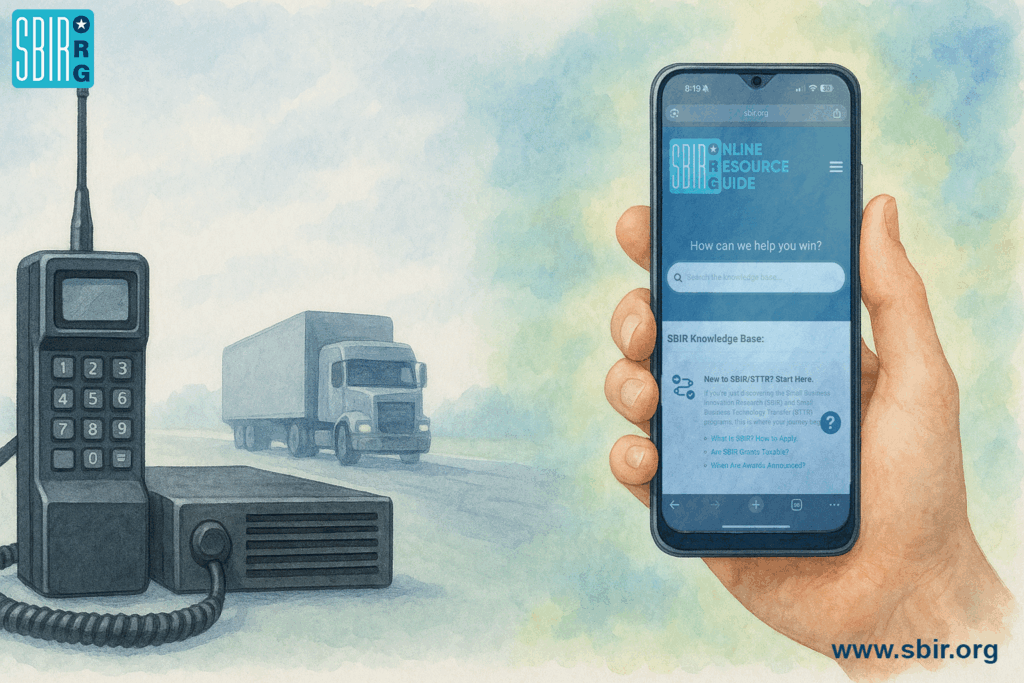
Qualcomm’s initial plan was to build a satellite-based communication system for long-haul trucking companies. The idea was daring: a network that would allow trucking dispatchers and drivers to send digital messages and track vehicle locations in real time via satellite. “Everyone was very skeptical that we could have a very small terminal that fits on a truck be low cost, and yet work over satellites designed for very large terminals,” Dr. Jacobs said of the challenge. For three years, the team toiled to make the concept work, developing a system they called OmniTRACS. In an era when wireless communication meant bulky car phones, Qualcomm set out to put a compact, affordable terminal on every truck. Skeptics abounded, but the technology eventually proved itself. “We managed to achieve that,” Jacobs recalled, and Qualcomm’s extensive marketing effort persuaded trucking fleets the system was worth the investment. By 1988, the breakthrough had arrived: the first major order for OmniTRACS came from Schneider National, a large trucking firm, providing Qualcomm with a much-needed influx of cash to grow. That early success not only validated Qualcomm’s technology – it gave the startup the capital and confidence to pursue even more ambitious goals.
Betting on a New Wireless Standard
Flush with revenues from the trucking communications business, Qualcomm set its sights on an even larger opportunity: the nascent market for mobile telephones. In 1989, the young company made a dramatic pivot from trucking to cellular technology, defying conventional wisdom in the telecom industry. At the time, the Telecommunications Industry Association had just endorsed a digital cellphone standard known as TDMA (Time Division Multiple Access). Qualcomm’s engineers, however, believed they had a better solution. Just three months after the industry backed TDMA, Qualcomm unveiled a competing technology called CDMA – Code Division Multiple Access. This unconventional approach, which let many users share the same radio frequencies by assigning unique codes, was widely viewed as risky and technically unproven. A Stanford professor even told Qualcomm that its idea “defied the laws of physics,” Jacobs later recounted. But Qualcomm pressed on, convinced that CDMA could dramatically increase network capacity and call quality for mobile phones.
Qualcomm’s bet on CDMA would prove prescient. The technology turned out to be superior in many respects, offering greater capacity and more robust service than its rivals. Within a few years, CDMA “would change the global face of wireless communications,” as the company’s own history puts it. By the mid-1990s, major carriers in the United States and abroad began adopting CDMA for their new digital cellular networks. Qualcomm, which had started the decade as a niche player, suddenly found itself at the center of the mobile revolution. Its patented CDMA techniques became core components of 2G and 3G wireless standards worldwide, meaning that every new mobile phone activated on those networks earned Qualcomm royalty revenue. The tiny trucking-communications outfit transformed into a mobile technology powerhouse whose innovations now power hundreds of millions of smartphones and other devices around the globe. Qualcomm’s chips and software became nearly ubiquitous in modern handsets, and the company cultivated a lucrative business licensing its portfolio of patented technologies to phone manufacturers. In essence, the risky bet on an unproven wireless standard paid off – spectacularly.
Crucially, this leap into cellular technology would not have been possible without sustained research and development – and here again the early SBIR funding played a quiet but pivotal role. The federal grants had funded several of Qualcomm’s high-risk R&D projects in the 1980s, including experiments with more efficient coding methods and an early application-specific integrated circuit (ASIC) for wireless use. Those efforts laid groundwork for the CDMA system. “This funding allowed us to pursue several innovative programs that otherwise would not have been possible,” Dr. Jacobs testified, explaining that one SBIR-backed project to develop a custom chip became **“a first step in a business that now brings in about two-thirds of our revenue.”* In other words, the public seed money helped Qualcomm build the very chip design expertise that would later yield its multibillion-dollar Snapdragon mobile processors. SBIR support also conferred credibility. “SBIR provided one source of that critical start-up funding … one of the critical ‘stamps of approval’ that allowed us to successfully pursue private capital,” Jacobs said, emphasizing how important that early validation was to a company attempting something so novel.
A 116,567‑Fold Payoff
Qualcomm’s headquarters in San Diego. From a handful of employees in a small room, the company has grown into a global semiconductor and wireless technology leader.
The payoff from those early investments has been extraordinary by any measure. In the span of just two decades, Qualcomm grew from a modest staff of 35 to a global workforce of over 17,500. A company that once operated on a shoestring now posts annual revenues in the tens of billions; by the mid-2010s Qualcomm’s market capitalization had already surpassed $80 billion. Today, its market value hovers around $174 billion(**), and it holds more than 13,000 patents, licensed by nearly 200 manufacturers worldwide. The once-tiny startup has become, in Dr. Jacobs’s words, “the world’s largest fabless semiconductor company,” a cornerstone of the global mobile industry. Perhaps most impressively, the company that began with a few government research contracts and a dream is now a pillar of American technology – one that has returned far more to the economy than it ever received. Qualcomm paid $1.4 billion in federal taxes in a single year (2010), Jacobs noted, far exceeding the total SBIR grants it received, “and this does not include the personal taxes paid by thousands of Qualcomm employees.”
For the SBIR program, Qualcomm stands as a blockbuster success story – the kind of outcome policymakers only imagine in their most optimistic projections. A relatively small public investment in high-risk, cutting-edge research helped spark the creation of an entire industry and a company worth over a hundred billion dollars. “By any measure, those SBIR investments by the federal government have paid enormous dividends to the taxpayers,” Jacobs told Congress. Indeed, the initial $1.5 million grant has translated into a corporation with a market cap around 116,000 times that amount – an almost 116,567-fold return on the taxpayer’s seed money. That staggering multiplier underscores how transformative the SBIR model can be: a targeted infusion of capital to a small, daring startup led to innovations that changed how the world communicates. Qualcomm’s journey from a cramped den to a global telecommunications titan offers a compelling case study in the outsized impact a little bit of early help can have – not just for one company, but for technology and society at large.
In the story of Qualcomm, the numbers speak for themselves. A $1.5 million bet by a government program helped unlock decades of innovation, tens of thousands of jobs, and untold technological progress. The next time you text a friend or open an app on your smartphone, it’s worth remembering that it all traces back to a risky experiment funded by a humble grant – one that turned out to be extraordinarily well spent.