How SBIR Fuels Big Pharma Breakthroughs
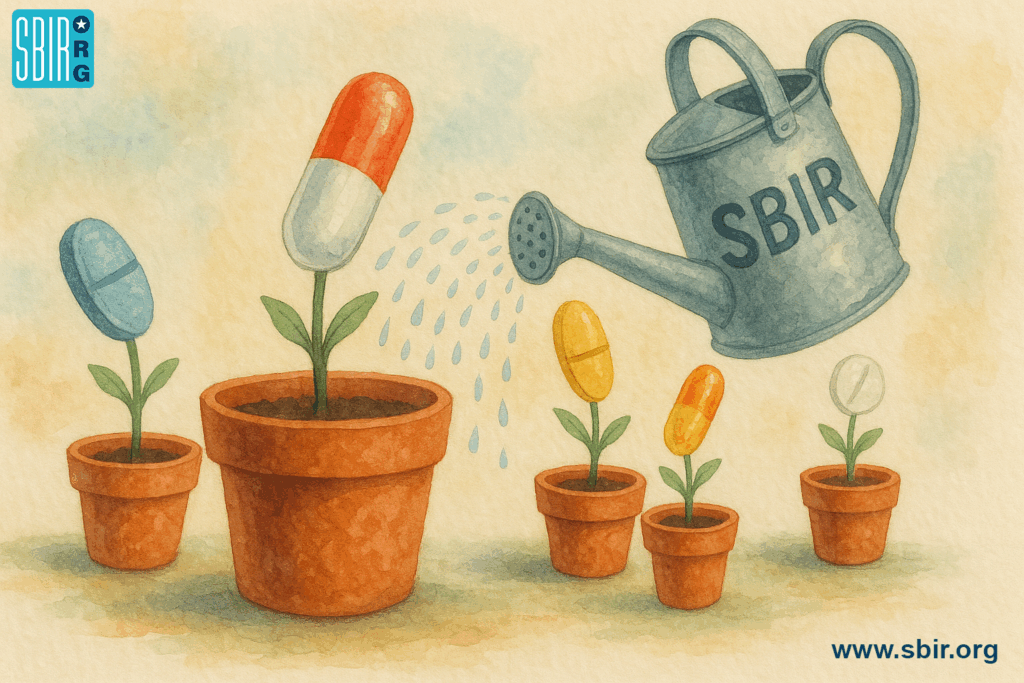
In a modest Maryland laboratory a few years ago, a small biotech startup celebrated an outsized victory: the U.S. Food and Drug Administration had just approved their new cancer drug. It was a moment of triumph not just for the dozen scientists in that lab, but for a little-known federal program that helped launch their work. For decades, the Small Business Innovation Research (SBIR) program has quietly fueled breakthroughs like this – game-changing medicines born not in Big Pharma boardrooms, but in startups and small research companies. Now, new data is turning the notion of who really drives medical innovation on its head.
A Surprising Share of New Medicines
It sounds improbable: between 1996 and 2020, 99 new drugs – roughly 12% of all new pharmaceuticals approved by the FDA – were developed by companies that received SBIR or sister STTR grants(**)(**). Even more striking, 16% of the “priority review” drugs approved in that period came from SBIR-funded firms. Priority review status is reserved for therapies seen as major advances – the most novel, impactful treatments. In other words, some of the biggest drug breakthroughs of the last quarter-century have sprung from some of the smallest research enterprises.
These findings, from a National Academies study, challenge the common assumption that pharmaceutical giants alone produce new cures. “It’s a remarkable statistic,” says Dr. Elaine Panangeas, a former NIH official who has overseen both big pharma partnerships and small-business grants. “We expect innovation to come from industry behemoths, but here we see the little startups punching far above their weight.” The data suggest that a federally funded seed grant to a tiny lab can yield a therapy that changes medical practice. It underlines how SBIR – a program created in 1982 to spur technological innovation by small businesses – has become an unsung engine for lifesaving drugs. With an allocation of only about 3.65% of federal extramural research funding, SBIR has long produced outsized results in both government technology and commercial returns(**). In health, the payoff is measured in lives saved.
Lifesaving Therapies from Tiny Labs
For patients, the impact of these small-business breakthroughs is very real. Consider a few examples that have made a difference in everyday medicine:
- A Cure for Hepatitis C: In 2013, a new pill called Sovaldi revolutionized Hepatitis C treatment, boasting cure rates above 90% for a disease that once often led to liver failure. The drug’s origins trace back to a SBIR-funded startup. Pharmasset Inc., a little-known Georgia biotech, received NIH SBIR grants in the early 2000s to develop antiviral compounds(**). The result was sofosbuvir – later branded Sovaldi – which global giant Gilead Sciences acquired for $11 billion in a high-profile deal(**). Today, sofosbuvir-based therapies have cured hundreds of thousands of patients, a feat made possible by one small company’s innovation.
- New Hope for Aggressive Breast Cancer: When Immunomedics, a New Jersey biotech with a few dozen employees, began developing an experimental drug for triple-negative breast cancer, few big investors took notice. Backed in part by SBIR funding from the National Cancer Institute, Immunomedics persevered. The therapy they created – Trodelvy (sacituzumab govitecan) – won FDA approval in 2020 and has extended the lives of women with an aggressive cancer that had limited treatment options(**). Its success was so compelling that Gilead (once again) acquired Immunomedics for $21 billion, ensuring this small-company discovery reached patients worldwide.
- A Breakthrough in Lymphoma: In the late 1990s, Seattle Genetics was a scrappy biotech startup working on a new idea to treat lymphoma by linking targeted antibodies to potent toxins. With early support that included SBIR grants from NCI, the company developed Adcetris (brentuximab vedotin), a drug that has dramatically improved outcomes for Hodgkin’s lymphoma. Adcetris was the first new treatment in decades for that disease when approved in 2011, and it has since helped thousands of patients achieve remission. The once-small Seattle Genetics (now renamed Seagen) grew on the strength of that SBIR-fueled innovation – and was recently bought by Pfizer for a staggering $43 billion, underscoring how valuable its homegrown cancer therapies became(**).
These are just a few of the SBIR success stories hiding in plain sight. Such drugs are not obscure one-offs; many target illnesses that families everywhere know – cancers, infectious diseases, chronic conditions. From a novel cystic fibrosis drug that improved lung function in children, to pioneering immunotherapies and precision medicines, SBIR-backed firms have delivered treatments that truly matter to public health. “A number of SBIR/STTR awardees have introduced medicines with profound impact on health,” the National Academies report noted, including drugs with hundreds of millions of dollars in sales due to their broad use. In some cases, these small labs have literally helped save lives by providing cures or critically needed therapies when few others were investing in those areas.
Outsized Impact from “America’s Seed Fund”
The SBIR program is often dubbed “America’s Seed Fund,” and its track record in biomedicine shows why. SBIR grants are competitive, peer-reviewed awards – typically a few hundred thousand dollars in Phase I, and up to $1 million or more in Phase II – aimed at high-risk, early-stage R&D by companies with fewer than 500 employees. For a young biotech firm operating on a shoestring, an SBIR grant can be make-or-break. “It’s not just the money, it’s validation,” explains Dr. Maria Lopez, founder of a Maryland startup working on an SBIR-funded vaccine project. “When NIH or another agency bets on you, private investors take notice.” That dynamic has led SBIR-backed companies to attract venture capital and partnerships that propel their innovations forward(**).
Indeed, studies show that SBIR awardees are twice as likely to secure patents and venture funding compared to similar companies that applied but did not receive grants. Many go on to achieve major milestones: Since 1996, over 800 SBIR-recipient firms have gone public or been acquired by larger companies. In the pharma sector, this often means a big pharmaceutical company licenses or buys the small company’s drug to fund expensive late-stage trials and marketing – effectively scaling up the cure born in the small lab. The acquisitions of SBIR-supported innovators like Pharmasset, Immunomedics, and Seagen by industry giants are prime examples. In total, more than 2,100 SBIR-funded firms have been acquired over the years, injecting their innovative technology into corporate pipelines. Rather than replacing big pharma, these startups have become a vital feeder system for it.
All this has been achieved with surprisingly little cost to taxpayers. The SBIR program accounts for just 3–4% of the NIH’s research budget (and similar small fractions at other agencies). Yet by one estimate, SBIR grants at NIH have yielded 99 new drugs while making up under 4% of its R&D spending. That leverage – big cures from small investments – is, as experts note, virtually unheard of in government programs. Objective analyses across agencies found returns on investment ranging from 22:1 to 33:1 for SBIR Phase II projects. In the National Cancer Institute’s portfolio alone, every $1 in SBIR/STTR funding translated to $11 in eventual commercial sales of products. Little wonder that advocates call SBIR one of the nation’s most effective innovation engines.
The Road Ahead: Nurturing the Next Breakthrough
This outsized success has not gone entirely unnoticed in Washington. The SBIR program, launched in 1982, has won bipartisan praise over the years and been emulated by at least 17 other countries. Yet it also faces periodic scrutiny. As of this writing, Congress is debating SBIR’s reauthorization and considering rule changes aimed at preventing abuse of the program by so-called “SBIR mills” – companies that win many grants without producing results(**). Some lawmakers have questioned whether tax dollars should go into startups at all, suggesting the private sector could fund innovation on its own. But supporters point to the unique role SBIR plays in bridging a critical gap: the risky early phase of research when potential breakthroughs are too unproven to attract big investors. The data, they argue, speak loudly. “If 12% of our new medicines are coming from SBIR companies, then we’d be crazy not to keep investing in them,” says Jere Glover, executive director of the Small Business Technology Council, in recent testimony. Defense Secretary Lloyd Austin – looking at SBIR’s impact on technology and defense – put it bluntly: we should “double down” on SBIR/STTR.
For healthcare, doubling down could mean more breakthroughs for diseases still in need of bold ideas. The next cancer cure, or a vaccine for a stubborn virus, or a therapy for Alzheimer’s might be percolating right now in a tiny startup, run by passionate scientists with a big dream and a small budget. Programs like SBIR give those dreams a fighting chance. They ensure that promising science in a garage lab can survive long enough to prove itself – and perhaps become the next miracle cure.
For the countless patients who have benefited from these small business, big pharma breakthroughs, the source of the innovation is largely invisible. But as the numbers reveal, it may be time to recognize and celebrate the outsized role that America’s little labs and startups play in delivering big cures – with a boost from a farsighted federal program that bets on the underdogs.