
SBIR Reauthorization Standoff Persists as Defense Bill Moves Forward
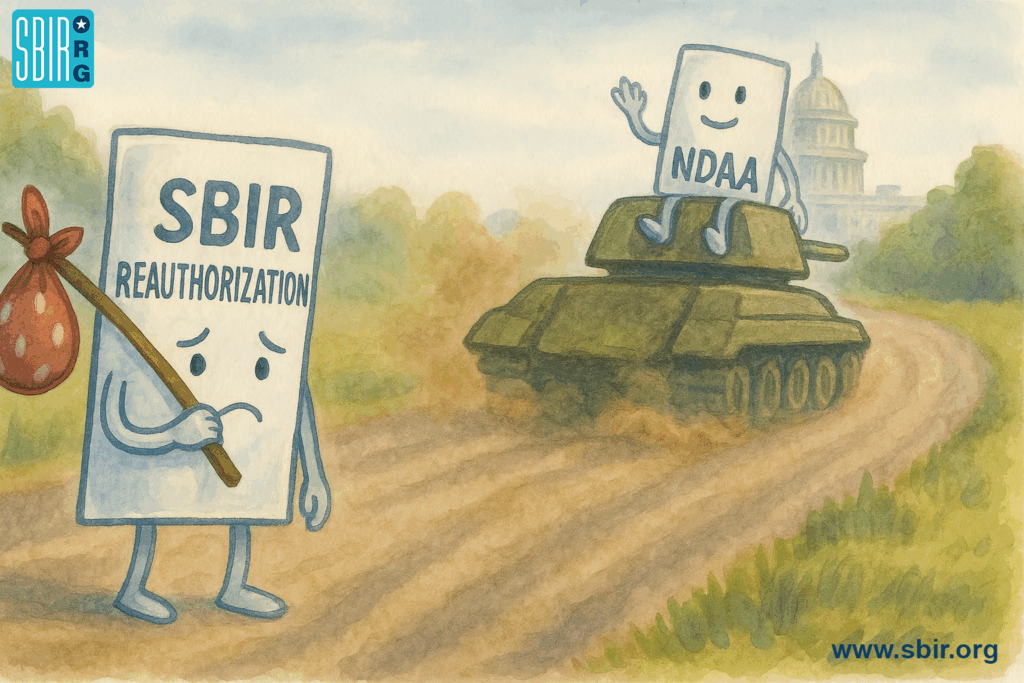
A must-pass defense policy bill is advancing on Capitol Hill without a lifeline for the nation’s premier small-business research programs. Congressional negotiators omitted an expected provision to renew the lapsed Small Business Innovation Research (SBIR) and Small Business Technology Transfer (STTR) programs from the final National Defense Authorization Act (NDAA) agreement unveiled on Sunday, December 7, 2025(**). The exclusion means the SBIR/STTR programs – key drivers of federal innovation funding for startups – remain in limbo, months after their authority expired on Oct. 1. This break from tradition is striking: in past years, lawmakers often used the annual NDAA to keep SBIR alive (notably in 2011 and 2016, when NDAA bills carried multi-year SBIR extensions(**)(**)). But this year, an internal impasse has blocked even a short-term fix.
At the heart of the deadlock is a jurisdictional tug-of-war involving six top lawmakers – the Republican and Democratic leaders of the House and Senate small business committees, along with their House Science Committee counterparts – dubbed the “six corners.” House and Senate Armed Services Committee leaders had signaled they would not tuck an SBIR extension into the defense bill without buy-in from all six players. That consensus never came. Five of the six corners were prepared to endorse a clean SBIR/STTR renewal – a one-year extension with no policy changes – which easily passed the House in September as H.R. 5100(**). The lone holdout was Senator Joni Ernst, Republican of Iowa, who chairs the Senate Small Business panel. Ernst refused to accept a no-strings-attached extension and instead insisted on folding in her own sweeping overhaul proposal, known as the INNOVATE Act(**), which you can read more about here.
“By trying to bypass other chairs and ranking members, Sen. Ernst is sidestepping the standard process for bipartisan negotiations,” charged Rep. Nydia Velázquez of New York, the top Democrat on the House Small Business Committee, as tensions flared last month. Ernst’s push for reforms stems from concerns that SBIR has been exploited by so-called “SBIR mills” – repeat grant winners that, she argues, never transition their research into usable products(**). Her INNOVATE Act proposes strict new limits, including a lifetime cap of $75 million on a company’s SBIR awards, along with tougher vetting of firms’ foreign ties(**). Those measures have proven controversial. Critics in both parties contend such caps would “micromanage a program that has thrived on an entrepreneurial spirit” and risk “boxing out” experienced innovators who have legitimately won multiple grants. Even some Republicans balked: House Small Business Committee Chairman Roger Williams warned he “will not rush provisions that jeopardize” small companies or dilute SBIR’s “proven value” to the nation.
Unable to agree on scope, lawmakers have now let the clock run out – a scenario with some historical precedent. During a previous reauthorization saga over a decade ago, Congress kept SBIR alive through 14 stopgap extensions between 2009 and 2011 while negotiating a longer deal. But Senator Ernst has flatly rejected any short-term renewal without her reforms attached, even if that means a protracted freeze. She has openly said she would rather see the program “kill[ed]” and its funding reverted to other Defense R&D accounts than reauthorize SBIR/STTR in its unchanged form(**). True to that stance, Ernst single-handedly blocked the House’s one-year extension in the Senate this fall, stalling reauthorization efforts and precipitating the October 1 lapse.
With SBIR’s fate unresolved, negotiations are expected to continue among the six-corner group to forge a compromise bill. Congressional staffers acknowledge that time is of the essence. The temporary government funding measure that ended the recent 43-day shutdown only keeps agencies operating through January 30, 2026(**). That looming deadline – when Congress must pass broader appropriations to avert another shutdown – is now viewed as the next viable vehicle to hitch an SBIR/STTR extension. Lawmakers and advocates are eyeing the January funding package as a chance to revive the programs if an agreement can be reached in time. Privately, some aides note that if all six corners miraculously reach accord before then, a stand-alone reauthorization could even be fast-tracked on the floor.
For now, the uncertainty weighs heavily on thousands of small R&D businesses that rely on SBIR grants. Federal agencies have been forced to freeze new SBIR/STTR award solicitations, though existing projects can continue on previously allotted funds(**). “A lapse creates uncertainty for innovators and risks slowing progress at a time when global competition is intensifying,” a bipartisan quartet of House committee leaders warned as the deadline passed(**). Those lawmakers – including Rep. Williams and Rep. Velázquez – stressed that the House’s stopgap bill would have safeguarded small firms “while both chambers continue to work toward reforms and long-term reauthorization”. In a joint statement, they urged the Senate to “move swiftly on a temporary extension” to plug the gap.
Such pleas from the House, industry groups, and even the Pentagon’s research chiefs have so far gone unheeded in the Senate. The Small Business Technology Council (SBTC), an advocacy group representing many SBIR recipients, has been sounding the alarm for months. SBTC and the National Small Business Association issued a joint release as soon as the lapse hit, imploring Congress to act “swiftly” to pass the one-year extension and restart the innovation pipeline. With each week that passes, pressure is likely to build on Senate leadership – and on Sen. Ernst – to find a stopgap solution. Otherwise, what began as a quiet legislative standoff could snowball into a broader setback for U.S. technological competitiveness. As SBTC’s executive director Jere Glover has cautioned, “SBIR/STTR programs are momentarily frozen not because they lack value, but because Congress has not yet resolved how to extend or reshape them”(**).